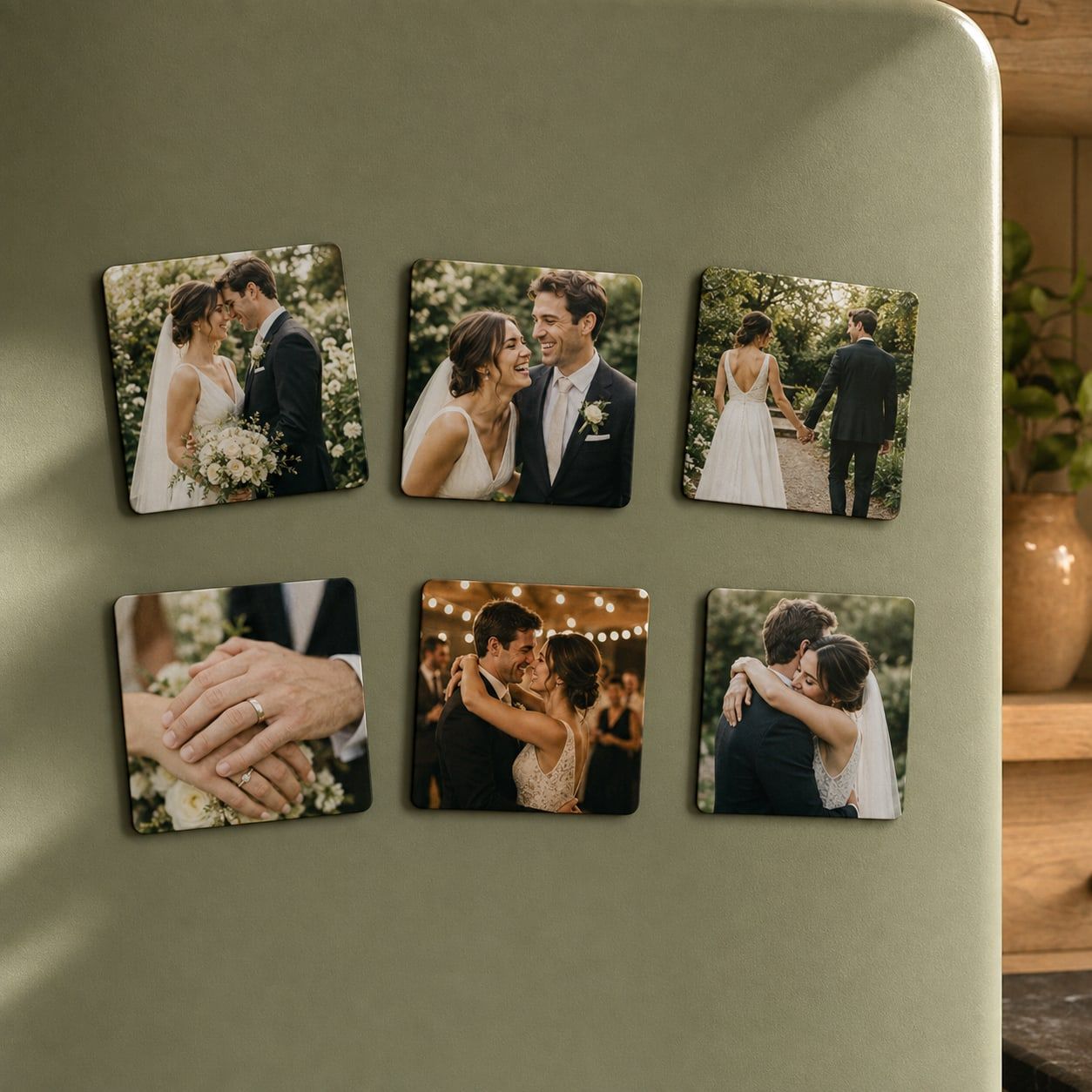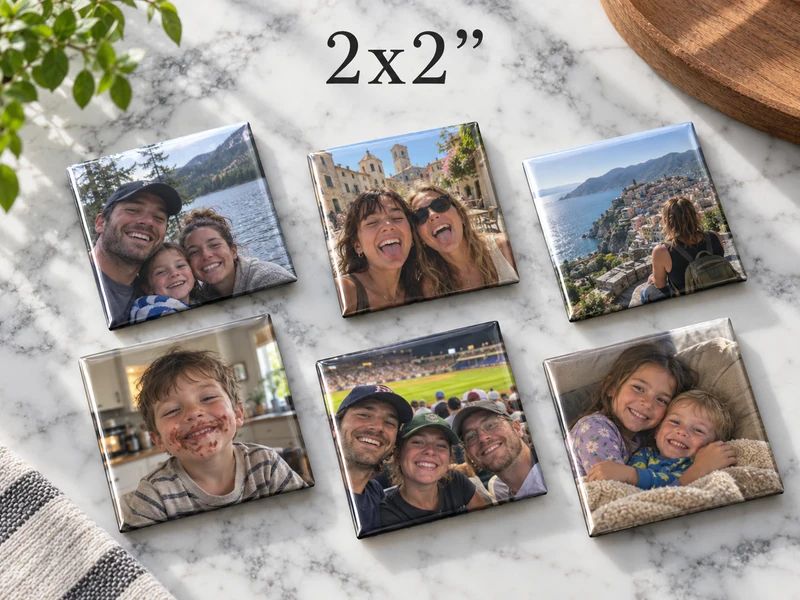
Choose 2x2 photo magnets for a compact portrait or a small display; choose 2.5-inch squares when the same photograph needs more physical room. Both are square, so the larger size changes the footprint, not the crop proportions.
- 2x2 photo magnets and 2.5-inch squares use the same proportions; both require a square crop.
- A 2.5-inch square has 56.25 percent more face area than a 2-inch square.
- Sticky Moments lists both sizes, with packs of 6, 9, 12, or 15.
- Choose the picture and available display space before deciding the size and quantity.
2x2 photo magnets or 2.5-inch squares: which fits your photos?
The difference is half an inch along each side. That can sound small until you lay out several pieces together, but it is not a change from square to a different shape.
The 2x2 Square Photo Magnets are described for a single face or a pet. The 2.5 Inch Square Photo Magnets are described with room for two faces or a little more background. Those descriptions are starting points, not a rule that counts heads for every photograph.
| Choice | Best for | Face area from listed dimensions | Main limitation |
|---|---|---|---|
| 2 x 2-inch square | A close-up subject and a compact arrangement | 4 square inches | Small background details become harder to see |
| 2.5 x 2.5-inch square | A pair or a larger version of a suitable square crop | 6.25 square inches | Requires more display space and still crops a wide image |
Choose the crop first, then choose how large that crop should appear. If a photograph cannot become square without losing something essential, neither square size solves the real problem.
What does the extra half-inch actually change?
The printed face dimensions change from 2 x 2 inches to 2.5 x 2.5 inches. Multiplying each pair gives 4 square inches and 6.25 square inches respectively.
That is 2.25 additional square inches, or 56.25 percent more face area. This is a calculation from the listed dimensions, not a measured claim about print quality, materials, or how easily someone will recognize a face.
Each side is 25 percent longer. The extra area is greater than that because both width and height increase. That is why a modest-sounding change can be noticeable when you compare the footprints on a real fridge door.
Keep the distinction clear: more area gives the picture more room on the surface. It does not add detail to a file or undo an unsuitable crop.
Choose 2 x 2 inches for a small, focused picture
A close-up with one obvious subject is a useful place to start. A child's expression, a pet's face, or a detail from a favorite day can remain clear without asking the frame to carry a whole scene.
The compact footprint is also useful when you want several pictures together without filling the available space. That is a layout choice, not a reason to include weak photographs just because they fit.
Keep the subject easy to find
Look at the square preview and ask what your eye finds first. If it takes effort to find the person among furniture, trees, or other people, compare a tighter crop or another image.
- Start with the original file.
- Keep the important face well inside the edge.
- Remove background that adds nothing to the memory.
- Compare the crop at a small viewing size.
Best for: a clear face in a compact format. The limitation is a picture that relies on small background details or several people spread out across the frame.
Leave room around the head
A close-up doesn't mean cutting right against hair, ears, or a hat. A little space can make the frame look deliberate instead of accidental.
Check a pet's ears and whiskers with the same care. If the composition only works when the crop presses against something important, a different photograph can be better than more adjustment.
Choose 2.5 x 2.5 inches for more presence on the door
A larger square gives the same suitable image more physical room. It can help when you like the square crop but find the smaller footprint too modest for the planned display.
A pair sitting close together is another useful starting point. The extra room can make the composition feel less cramped, although two distant people in a large scene don't automatically become a strong small print.
Judge the faces, not the number of people
There is no universal rule that one size is for one person and the other is for two. Camera distance, framing, and the original image all matter.
- Look at how much of the crop each face occupies.
- Keep important hands or shared objects inside the boundary.
- Check whether the background explains or distracts.
- Compare both footprints on the intended surface.
Best for: a suitable square photograph that deserves more space. The tradeoff is a larger footprint for every piece in the set.
Don't use the larger square as a file-repair tool
A larger version can make missing detail or softness more noticeable rather than repair it. Review the actual image and avoid relying only on a small thumbnail.
If the file looks poor, ask for an original or a better version before choosing a format. An emotional picture can still be worth keeping, but make the compromise knowingly instead of expecting the product to restore information.
Why neither square fixes a wide group photograph
Both formats have equal width and height. A wide line of people has to lose some width, retain empty space another way if the ordering tool supports it, or use another format.
The larger square gives more printed area to the crop you keep. It doesn't bring the outer people back. If you repeatedly move the crop from left to right trying to save everyone, compare a rectangular format instead.
The collection lists a 2 x 3-inch rectangle for scenes that need a wider or taller frame. That isn't proof that the entire original file fits unchanged, so check its preview too.
Choose the format with the least important loss. A photograph with a clear shared memory is worth more than a perfectly matching set of outlines.
Plan the display using the actual dimensions
Paper cutouts are an easy way to compare size without buying anything. Cut a 2-inch square and a 2.5-inch square, then put them beside the space where the photos will live.
This test shows footprint only. It doesn't demonstrate the backing, finish, or print quality of the product, and it doesn't prove the intended surface is magnetic.
For a simple three-column row, three 2-inch squares total 6 inches across before gaps. Three 2.5-inch squares total 7.5 inches before gaps. These are arithmetic examples based on the dimensions, not recommended spacing or a claim about a required layout.
Leave room for the door's handles, existing notes, and anything else that needs to remain. A kitchen is allowed to keep being a kitchen after the gift arrives.
If the set is a surprise, ask for a recent photograph of the intended display area. It gives you a practical reference without asking the recipient to choose the present themselves.
Choose a pack without padding the photo list
Sticky Moments lists packs of 6, 9, 12, or 15 for these formats. Start with the number of photographs you actually want to display, then compare the current options.
Don't choose a bigger pack merely because you struggled to narrow the camera roll. Near-duplicates can be lovely when the changing expression is the point, but they can also crowd out the pictures that tell a different part of the story.
A good shortlist might include a close-up, a shared activity, and a picture with the recipient in it. Treat that as an editing idea, not a required recipe for every family.
If you plan to divide a purchase between households, confirm the order details and packaging rather than assuming it arrives as separately prepared gifts. Quantity and presentation are different decisions.
Which square makes sense as a grandparent gift?
Start with the recipient's actual display space and preferences. A compact row might suit one kitchen, while a larger pair of faces might suit another.
If the grandparent likes photographs with context, don't automatically crop every picture to a headshot. The garden, chair, or familiar doorway might be part of what they want to remember. Compare the larger square or a rectangle before removing that detail.
Sticky Moments photo magnets suit shoppers choosing a small family-photo display across several listed formats. They are not a substitute for a larger print when the photograph needs much more room.
The thought is in the selection. A smaller set of clear, meaningful images is not a lesser gift than a larger set of photographs chosen only to reach a quantity.
Before placing the order
Review the current product page, selected dimensions, quantity, and every crop. Keep the original files available so you don't accidentally upload an older edited copy.
Sticky Moments identifies Fresh Magnets as its printing and shipping partner. Check current ordering and delivery information at the purchase stage; this November 2026 comparison does not establish a delivery date or promise a print result.
Finally, confirm that the intended door or board holds magnets. A cutout shows size, but an existing magnet on the actual surface is the useful compatibility check.
FAQ
How much bigger are 2.5-inch squares than 2x2 photo magnets?
Each side is half an inch longer. The listed face area increases from 4 to 6.25 square inches, a 56.25 percent increase calculated from the dimensions.
Does a 2.5-inch square show more of a wide photograph?
Not automatically. Both sizes use a square crop, so increasing the size doesn't restore the sides of a wide image.
Are 2x2 photo magnets too small for two people?
Judge the specific crop rather than using a strict head count. Two faces close together can work differently from two people standing far apart.
Which size is better for grandparents?
Choose around the recipient's display space and the selected photographs. The larger square gives a suitable crop more physical room; the smaller square keeps the footprint compact.
Can I compare sizes before ordering?
Yes. Paper squares cut to 2 inches and 2.5 inches show the difference in footprint, although they don't preview print quality or magnetic compatibility.
What pack quantities does Sticky Moments list?
The listed square formats have packs of 6, 9, 12, or 15. Check the current product and checkout options before ordering.
One last thing
The larger square is more space, not more memory. Choose the photograph you would keep even if you were only printing one, then give it a frame that lets it work.